
The Bamboo Renaissance
From global award‑winning projects to Australian buildings, discover how engineered bamboo is redefining design and structural performance.
By Jennifer Snyders | BScArch, CEO, House of Bamboo
If you’ve followed recent architecture news, you’ve likely seen coverage of the Wang Fuk Court fire in Hong Kong last year: over 150 lives lost, bamboo scaffolding blamed, and calls to phase out a centuries‑old building method.
Most coverage missed a critical point: the bamboo wasn’t the problem. Substandard plastic mesh, flammable polystyrene window seals, and inadequate fire‑retardant standards were. Yet bamboo became the scapegoat, reinforcing the misconceptions that stop architects from considering one of the most viable timber alternatives today.
I’m not writing to defend temporary scaffolding practices in Hong Kong, That’s a separate conversation about construction safety and standards. I’m writing because Australia faces a structural materials crisis that engineered bamboo can help solve, yet outdated assumptions keep getting in the way. First, we need to understand the scale of the problem.
The Numbers Don't Lie
Australia needs to build around 225,400 new homes per year through 2034 - that’s 2.48 million dwellings over the next decade and by 2050, housing demand will require fifty percent more construction timber than we use today. We know this translates into increasing pressure on specification: tighter budgets, longer lead times, and fewer low‑carbon structural options in the standard palette.
We already import 20–25% of our structural timber, and that dependence is projected to double by 2050 without a dramatic expansion of plantations. The NSW timber shortage alone is forecast to reach the equivalent of 250,000 house frames by 2035, while Victoria and Western Australia have closed their native hardwood industries and Queensland has ended state‑owned native timber harvesting in the SEQRPA. Even with the federal government’s 86 million dollar investment in new plantations, those trees will not be ready for harvest until around 2047. Commercial softwood take up to 30 years to mature. The question for design teams is simple: what scalable, certifiable materials can fill this structural and carbon gap within current project cycles?
Meanwhile, the Australian Government has legislated ambitious climate targets: a 43% emissions reduction by 2030, 62–70% by 2035 (as recommended by the Climate Change Authority and approved by government), and net zero by 2050. The construction sector is responsible for a large share of global CO₂ emissions, much of it locked into the materials we specify. In this context, material choice is no longer neutral; it has become a core design decision and a key lever in meeting both project budgets and carbon budgets.
Beyond the Misconceptions
Let me address the elephant in the room first. When architects hear “bamboo”, the responses are predictable: “Isn’t it invasive?” “It’s just a pole, right?” “Is it really suitable for structural use?”
The invasiveness concern is valid but misdirected. Yes, some bamboo species spread, but most don’t. Of more than 1,500 species globally, the majority are clumping varieties that stay where you plant them, and Australia has three native bamboo species that have existed in our ecosystems for millennia. The species we work with are non‑invasive clumpers that require no more management than a standard hedge.
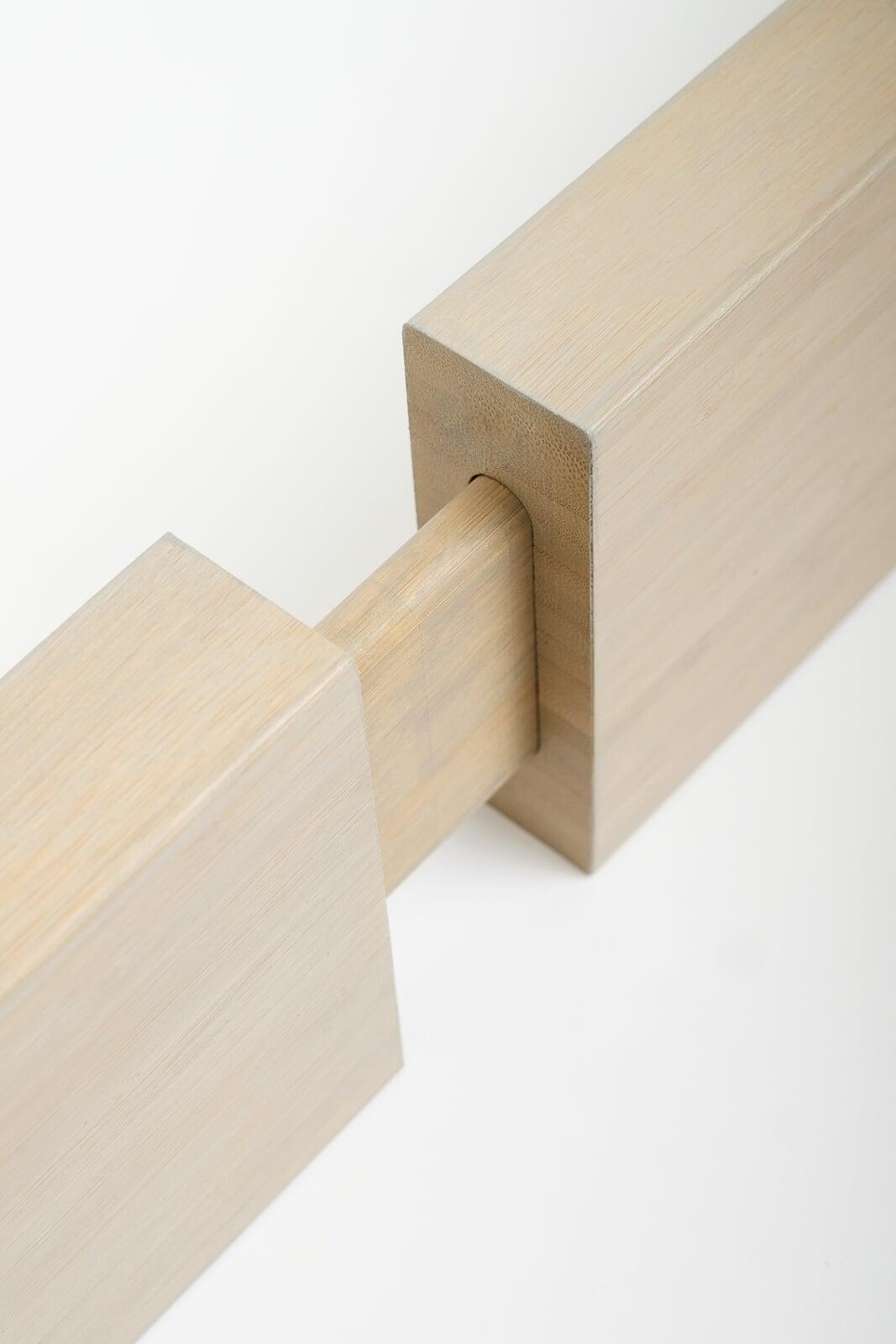
Bespoke Laminated engineered bamboo joint detail
The structural question deserves a detailed answer, because this is where the real shift has occurred. We are not talking about traditional poles, temporary scaffolding, or low‑grade plastic laminates. We are talking about timber‑like, precision‑manufactured composite products with consistent, predictable performance. Engineered bamboo is split into strips or strands, dried to a defined moisture content, treated for durability, and bonded under pressure with minimal resin to create panels, beams, and structural elements.
The result is a material with tensile strength greater than mild steel and compression resistance roughly double that of concrete. Research by MIT materials scientist Lorna Gibson found Moso bamboo to be stiffer, stronger, and denser than many North American softwoods used in construction, while Deakin University’s 2025 testing program confirmed that laminated bamboo delivers consistent, high‑performance compression results comparable to, or exceeding, traditional Australian softwoods.These datasets provide inputs for load‑bearing and serviceability checks in much the same way timber or steel properties do.
In October 2024, the International Organisation for Standardisation published ISO 7567:2024 for structural glued‑laminated bamboo, the first global ISO standard for this material, alongside ISO 22156 for structural design and ISO 22157 for testing methods. Practically, this means engineered bamboo can be integrated into performance‑based designs for elements such as beams, linings, and secondary structure, supported by recognised test methods and design rules.
It's Already Working Here
I want to show you what’s already happening in Australia. These aren’t conceptual projects, but occupied buildings where engineered bamboo performs exactly as specified.
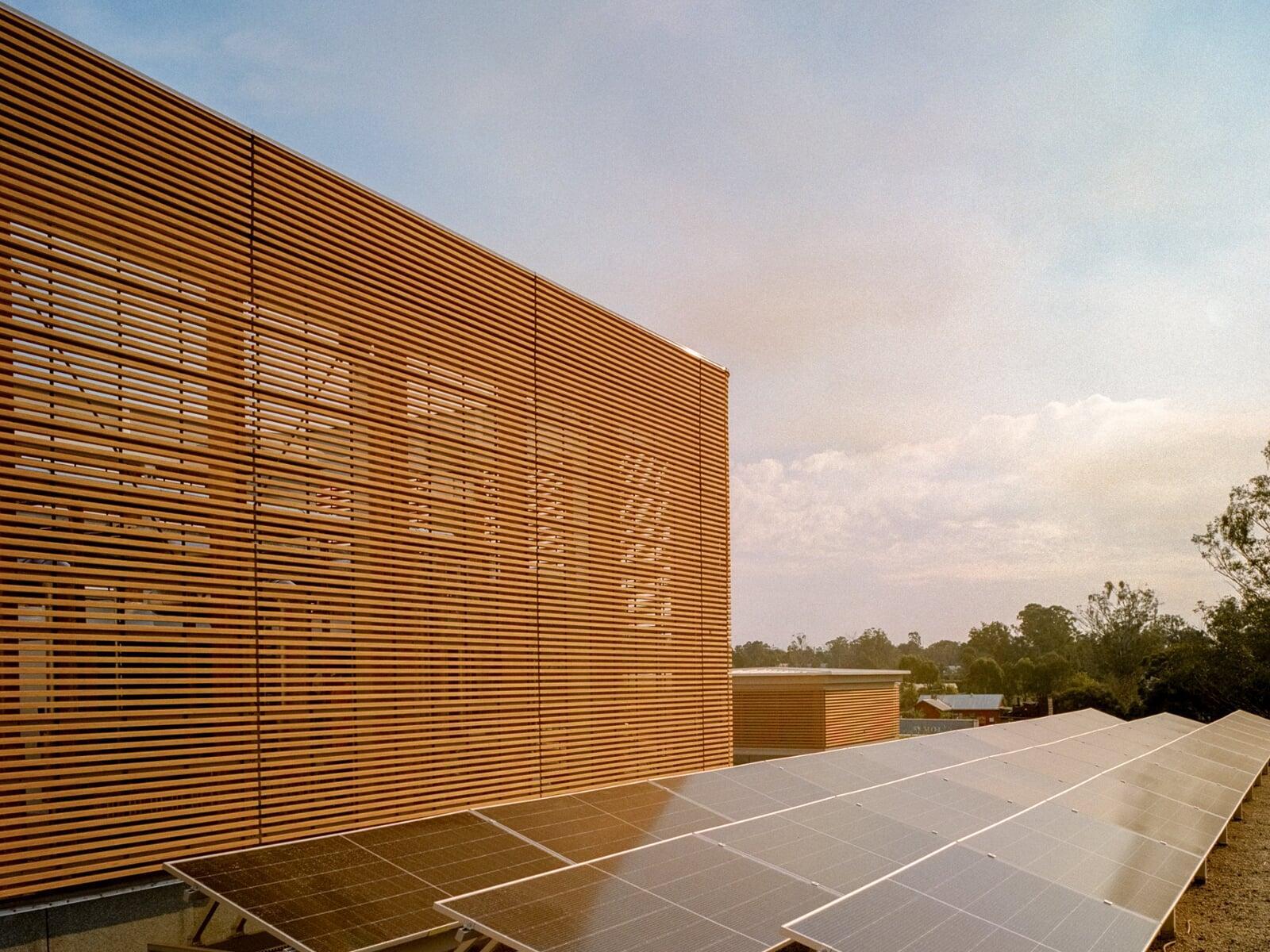
The First Building at Bradfield City Centre, designed by Hassell and Djinjama, is
the first major structure in a new Australian city in over a century
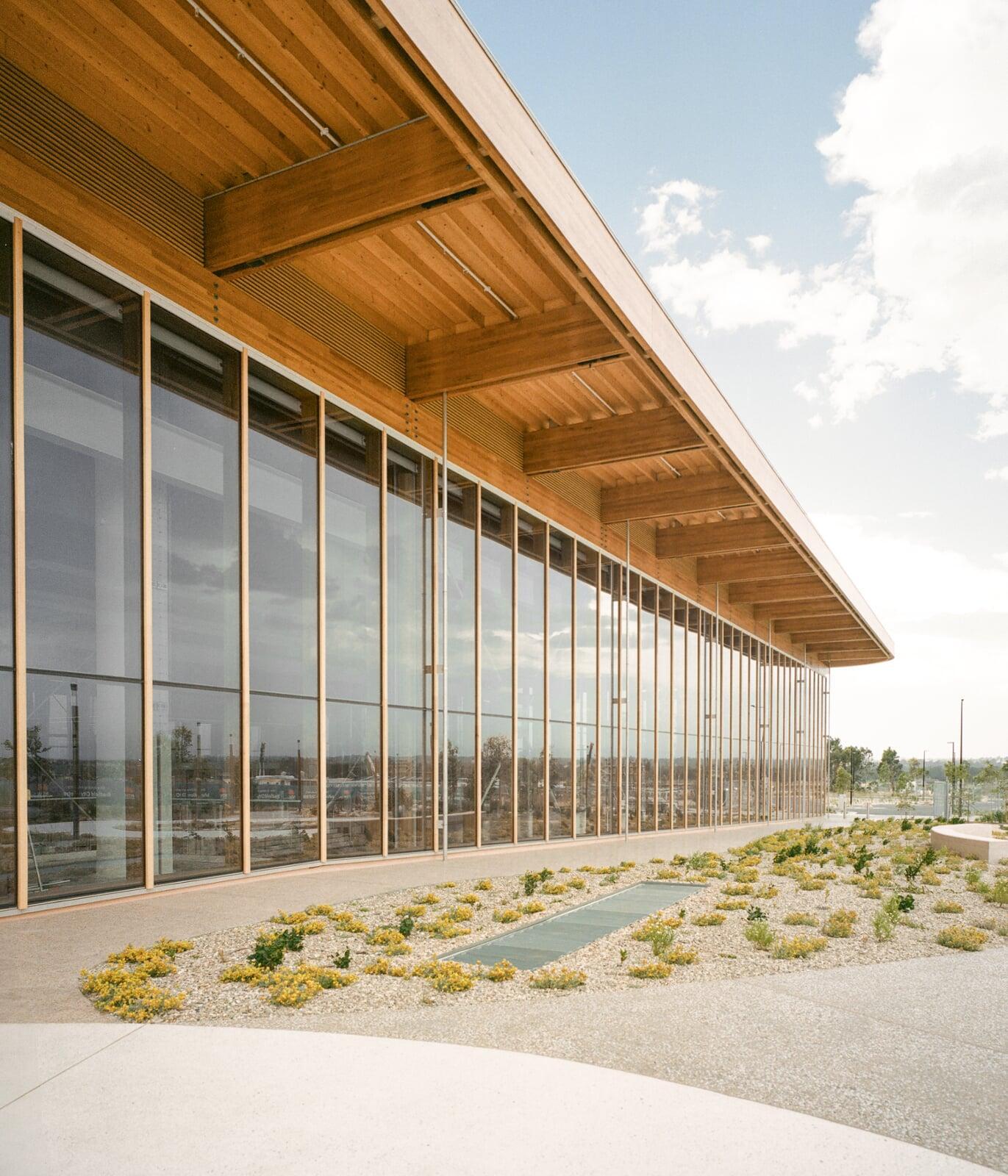
First Building AMRF, Bradfield City designed by Hassel
The brief called for a regenerative public building that materially reduced embodied carbon while delivering durability and performance suitable for a government facility. Engineered bamboo sits alongside timber and rammed earth as part of that strategy. House of Bamboo collaborated with the design team to adapt specifications, supply technical data for certifiers, and work with specialist engineers so that each bamboo element had a clear pathway under Australian building codes.
At Marvel Stadium in Melbourne, Hachem Architects’ Amphora dining venue features custom‑engineered curved bamboo ceiling beams. When the architects asked if we could create structural curves, the answer was yes and the result is a striking overhead feature that draws attention not because it’s sustainable, but because it’s beautiful.
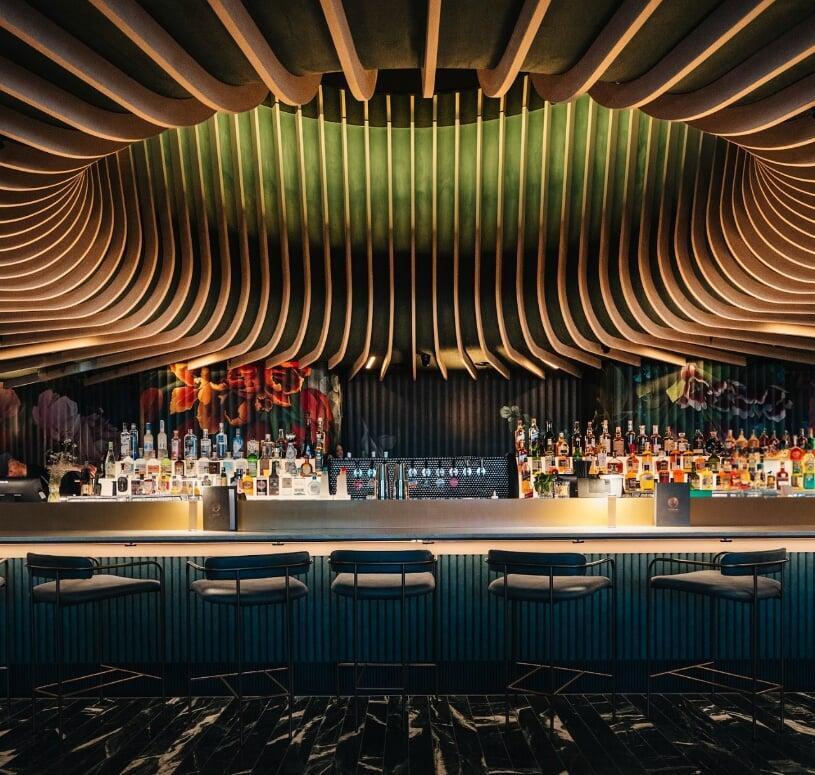
Amphora, Marvel Stadium, Melbourne, designed by Hachem Architects,
with bespoke curved interlocking battens
These spaces aren’t about acceptable compromises in the name of sustainability. They’re compelling environments people are drawn to because they feel good to inhabit. The biophilic response to natural materials is real; we’re hardwired to respond positively to them. Bamboo offers warmth, texture, and visual rhythm comparable to timber, with a distinct character of its own.
The Bamboo–Timber Distinction That Matters
This is crucial to understand: bamboo is not forestry; it is agriculture. Harvesting a tree removes decades of stored growth, then you replant and wait another 25–30 years before the next harvest. With bamboo, you manage a regenerating crop that reaches maturity in three to five years and can be harvested annually thereafter. The rhizome system remains in the ground, sending up new shoots each year.
Well‑managed bamboo plantations can yield up to 1,250 culms per hectare annually. Each hectare can capture between six and 24 tonnes of carbon per year, up to four times more than many hardwood species—and when that bamboo is manufactured into building materials, the carbon remains locked in for the life of the structure. For design teams, that faster growth cycle and higher carbon uptake translate into long‑term supply security and a material that actively supports embodied‑carbon reduction targets.
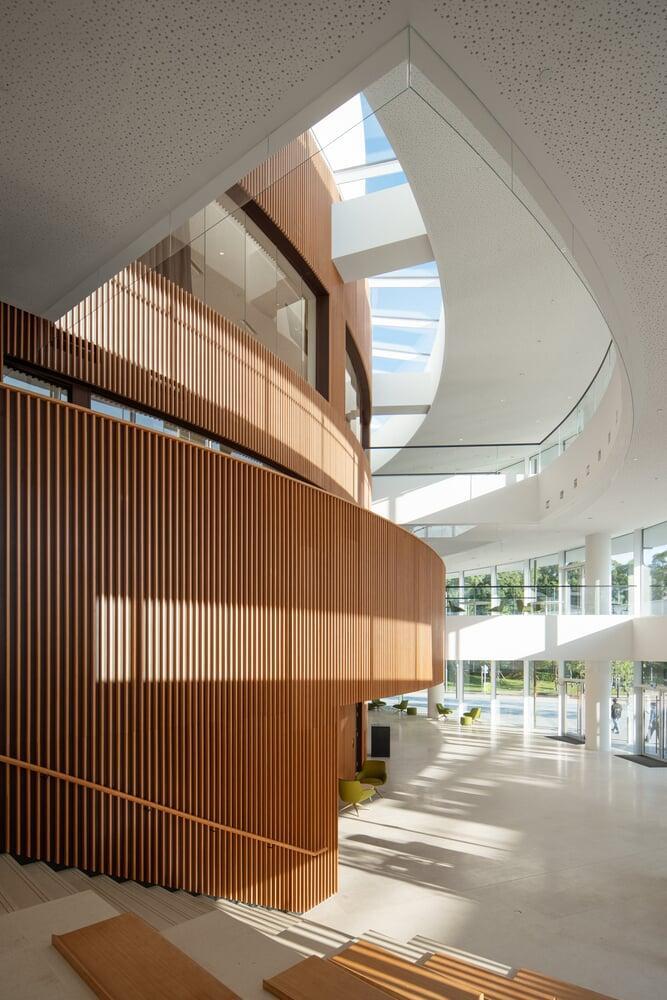
Award‑winning Shaw Auditorium at HKUST, HongKong designed
by Henning Larsen
This is why international architecture and engineering firms have been taking bamboo seriously for years. In Hong Kong, the award‑winning Shaw Auditorium at HKUST, designed by Henning Larsen, uses engineered bamboo for façade and acoustic performance while supporting BEAM Plus Platinum certification. In Colombia and Ecuador, more than 4,000 homes using composite bamboo shear wall systems have been built to earthquake‑resistant standards. In the Netherlands, research has shown that replacing even half the concrete in a typical new‑build house with fibre‑pressed bamboo can avoid around 60 tonnes of CO₂ emissions per dwelling. For Australian practitioners, these are proven applications and performance precedents that can be referenced when pursuing performance‑based solutions.
Australia's Advantage
Here’s where Australia is uniquely positioned and where the challenges are equally clear. Our domestic bamboo cultivation and processing capacity is still emerging, and local structural products are not yet available at the scale our construction pipeline will require. In the short term, that means relying on imported engineered bamboo while domestic growing and processing capability catches up.
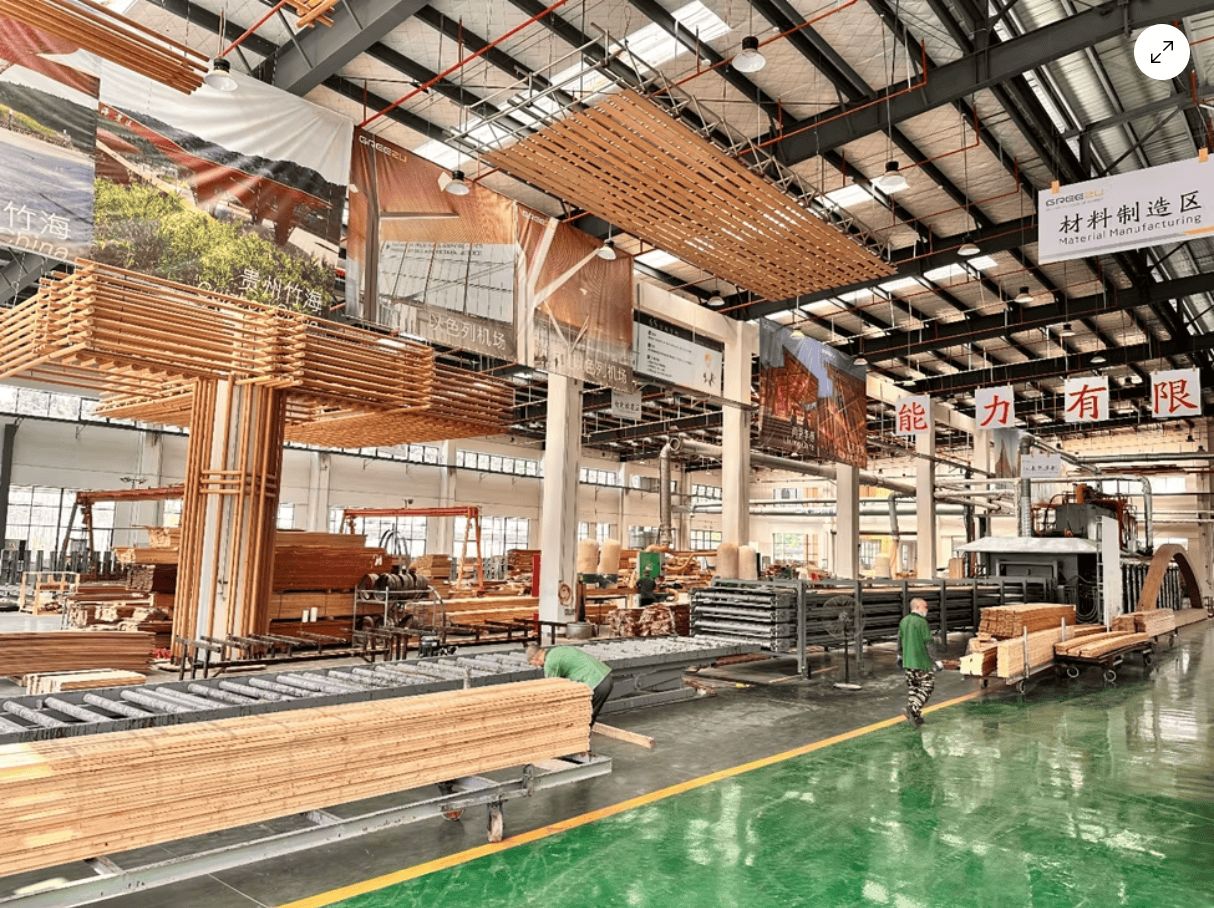
The advantage is that we already have access to some of the world’s most experienced mills producing premium engineered bamboo products. These manufacturers have decades of refinement behind them, with materials tested to international standards and proven in thousands of projects across multiple climates and building goals. When Australian architects specify engineered bamboo through suppliers like House of Bamboo, they are drawing on this global performance history rather than trialling an unproven product. This is not a beta phase; it is a transfer of established technology into a new market context.
Award‑winning Shaw Auditorium at HKUST, HongKong designed by Henning Larsen
The trade‑off is transparent: immediate access to high‑quality, certified products, alongside a planned pathway to increasing local supply as the Australian industry matures. Organisations such as the Bamboo Society of Australia are connecting growers, processors, designers, and researchers, but the knowledge base and infrastructure are still in their build‑up phase. For practitioners, participation in this movement means being early adopters in an Australian context, insisting on robust data, clear documentation, and practical approval pathways, while helping scale a material that can materially shift both our material security and our embodied carbon profile.
Advancing Beyond Boundaries
The barriers are no longer technical. The engineering is proven, and built projects worldwide already demonstrate what engineered bamboo can do.
What remains are perceptual and procedural barriers.
Many architects and engineers simply aren’t aware of how far engineered bamboo has evolved. The mental image often stops at traditional construction or lightweight applications, rather than at precision‑manufactured structural components with test‑verified performance. That’s a knowledge gap we can close through CPD education, seminars, built case studies, and early collaboration.
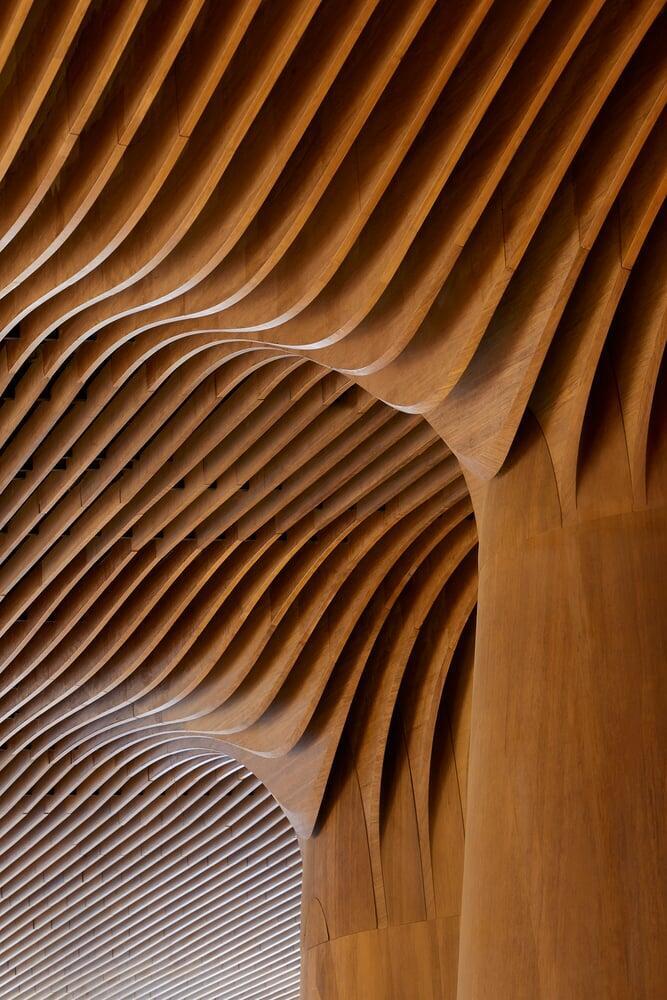
Engineered bamboo bespoke ceiling feature
There is also a practical challenge: building code acceptance and familiarity among certifiers and surveyors. This is normal. Every innovative material goes through this phase. CLT followed the same path, relying on performance‑based solutions and alternative approval routes before being written into prescriptive codes.
Engineered bamboo now sits at the same point, only this time we’re better prepared. The frameworks already exist and the industry knows how to use them. Performance‑based pathways can draw on established international testing, third‑party evaluations, and recognised certifications such as ICC evaluation reports and CodeMark, giving certifiers confidence when assessing new applications.
They establish precedent, demonstrate compliant pathways in practice, and give subsequent projects a reference point. Each approved project reduces friction for the next.
Working with specialist suppliers who understand both material performance and approval processes is essential. Beyond supplying material, our role is to provide documentation, test data, and technical support to navigate approvals. When these processes are clear and supported, innovative materials move from unfamiliar to accepted, just as CLT did.
The Carbon Imperative
We need to talk about net zero, because the policy landscape has shifted. Australia remains one of the world’s largest fossil fuel exporters, with a “Future of Gas Strategy” supporting production and export to 2050 and beyond, while the Climate Action Tracker rates our efforts as “Insufficient” for a 1.5°C pathway. At the same time, we subsidise fossil fuel industries by around $14.5 billion per year, more than ten times our annual investment in renewable technology.
This creates a clear paradox: climate targets demand rapid decarbonisation, while economic policy continues to support high‑carbon industries, and the construction sector sits in the middle trying to deliver housing at scale. This is exactly why materials like engineered bamboo matter. They offer a practical way to reduce embodied carbon in buildings without waiting for top‑down policy alignment, and every project that replaces high‑carbon materials with bio‑based alternatives moves the needle, cumulatively, incrementally, and measurably.
The Bigger Picture
Bamboo also offers something Australian architecture urgently needs: a regenerative crop that can restore degraded land while producing building materials.
Australia has extensive areas of degraded farmland, mine rehabilitation sites, and marginal soils suitable for bamboo cultivation. Its extensive root system stabilises soil, prevents erosion, and can even remediate contaminated sites, absorbing heavy metals and filtering pollutants. In a country grappling with ecological restoration challenges, bamboo offers a crop that restores while it produces.
This is the systems‑thinking we need. Not just ‘What can we build with?’ but ‘What can we grow that rebuilds ecosystems, sequesters carbon, creates economic opportunity, and produces materials we can build with?
A Closing Thought
Engineered bamboo is no longer an emerging idea; it is a proven, high‑performance material delivering real outcomes in buildings worldwide and here in Australia. The tools are already in place.
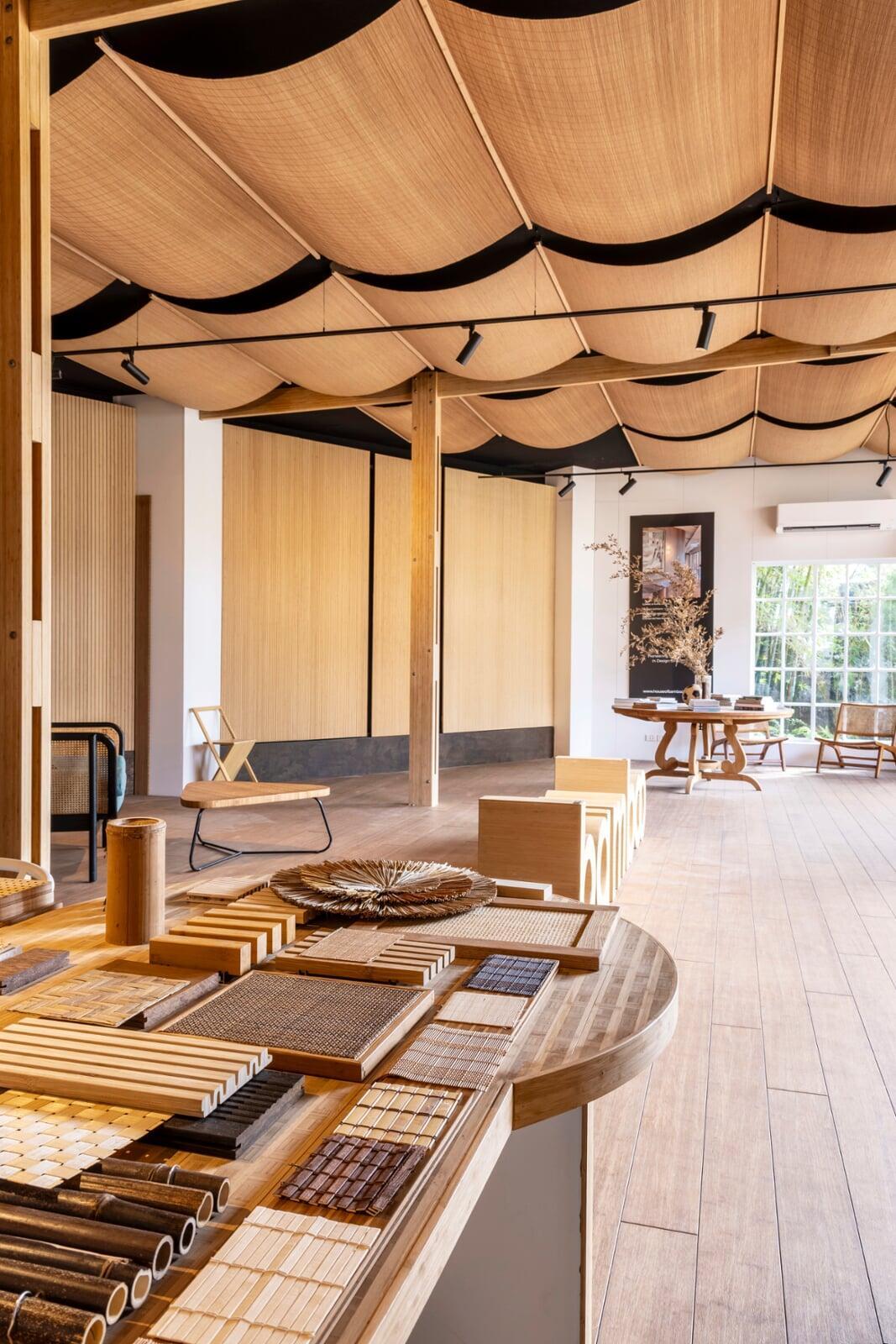
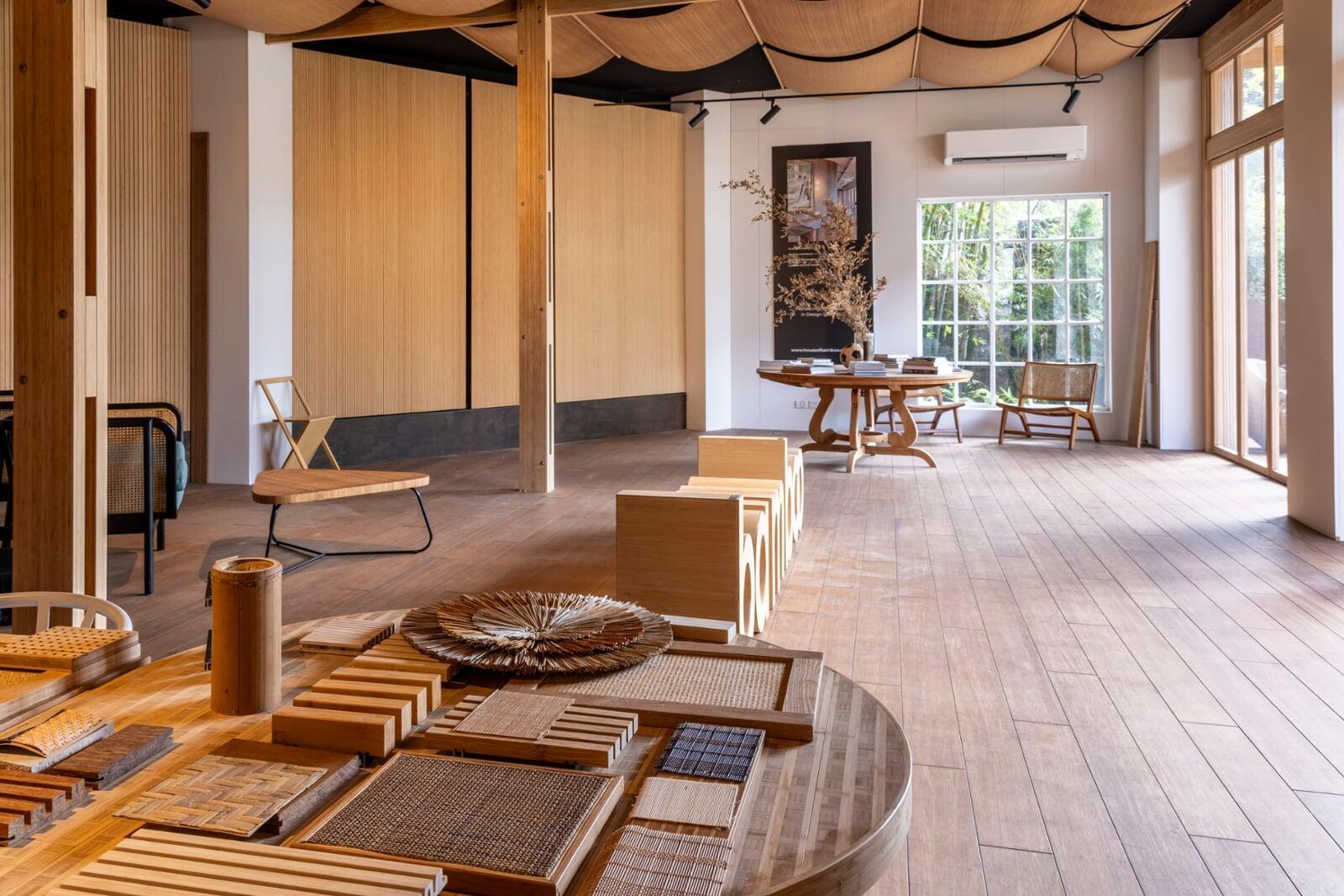
House of Bamboo Showroom constructed from Structural
and decorative engineered bamboo
At a time when we are grappling with housing shortages, material constraints, and climate targets, we also have access to mature bamboo technologies, established performance-based approval pathways, and growing local capability. What’s needed now is participation.
Architects willing to look beyond convention. Engineers and certifiers confident in applying performance frameworks. Policymakers and industry leaders open to materials that align climate responsibility with design excellence.
Engineered bamboo is not a replacement for timber, but a powerful partner, one that regenerates quickly, sequesters carbon efficiently, and can be crafted with precision and beauty. Each project builds confidence. Each approval makes the next easier.
The opportunity now is not to debate whether bamboo belongs in Australian construction, but to accelerate how it is thoughtfully and responsibly used. The invitation is simple: engage, collaborate, and build the momentum for engineered bamboo to become part of Australia’s mainstream construction future.